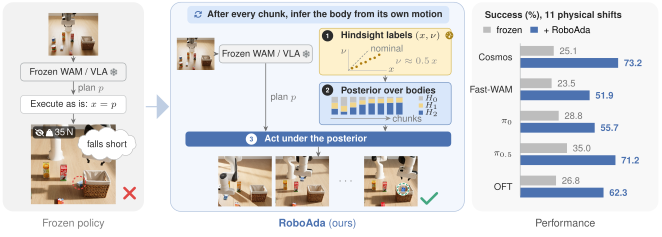
RoboAda infers the body that executes a frozen policy's plan. Under a 35 N load that is not visually apparent, the frozen policy executes its plan as trained and the cream cheese falls short (left). After every chunk, RoboAda turns proprioception into hindsight labels (1) and weighs explicit body hypotheses (2), then acts under the posterior (3). This more than doubles the average success of five frozen policies under eleven physical shifts (right). The photos are renderings of simulated episodes.
The plan is right. The body is not.
A full mug looks like an empty one, a block that looks wooden may be made of iron, and a worn joint looks like a healthy one. A robot policy plans under the physics of its training data, so on a changed robot its plan is often still right while the commands that carry it out fall short.
RoboAda keeps the policy and its plan unchanged and corrects the commands. After every action chunk it turns the robot's own motion into hindsight labels, weighs explicit hypotheses of the robot's body by how well they predicted those labels, and sends the next chunk as the commands that best realize the plan under this posterior. It needs no reward, no gradient step and no data from the changed robot, and it wraps world action models and vision-language-action models alike.
Try a hidden change
Both arms receive the same plans from the same frozen policy and should put the box in the basket. Pick what changed in the robot. Nothing in the scene shows it; RoboAda finds it in the arm's own motion.
A two-dimensional arm simulated in your browser, with the same three body hypotheses and the same latency test as RoboAda. It illustrates the idea; the results further down come from the paper.
How it works
RoboAda sits between a frozen policy and the robot and runs one loop per action chunk. The animation follows it on a robot whose command gain has silently dropped to one half.
Results
Five frozen policies on LIBERO, the world action models Cosmos Policy and Fast-WAM and the vision-language-action models π0, π0.5 and OpenVLA-OFT, each run on the same episodes with and without RoboAda. The inverse-dynamics models and priors are trained once on nominal rollouts and reused unchanged.
Against seven test-time adaptation methods, re-implemented at the same interface with the same hindsight labels, RoboAda leads on both groups of physical shifts and is one of two adaptive methods that keep the frozen policy's success when nothing has changed.
Success (%) of Cosmos Policy on held-out initial states. Actuation: command gain ×0.5, a gain drop, stiffness ×0.15. Contact and load: a 20 N force, a 35 N payload, two weakened joints.
The same settings carry over to another robot and action space: on bimanual RoboTwin 2.0 with joint-space commands, Fast-WAM rises from 24.9% to 78.8% under joint-target offsets.
The posterior identifies the change
The fitted body moves to the true one within a few chunks. Under a command gain of 0.3, 0.5 or 0.7 the fitted gain reaches the true value, and a payload or heavier objects show up as a downward offset that sets in only once the object is held.
Median over held-out episodes, with the interquartile range.
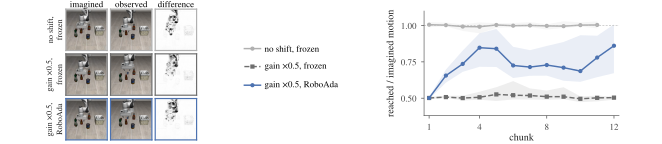
A world action model's own imagination registers the change too. Under half the command gain, the frozen robot reaches half of the motion the model imagines, and RoboAda recovers most of it within four chunks.
Left: imagined and observed frames after four chunks, and their difference. Right: reached over imagined motion per chunk, 80 held-out episodes.
Rollouts
Each clip shows the frozen policy on the left and the same policy with RoboAda on the right, from the same initial state under the same hidden change.
What the camera misses
The same recorded commands, replayed on the normal robot and on a changed one. The faint arm and the white path are the normal robot; the solid arm and the orange path, the changed robot. Nothing in the first frame tells them apart.
Code
The release depends only on numpy. A quickstart without any simulator runs in a few seconds, and your own policy plugs in through a Python function, an HTTP endpoint or an openpi server.
from roboada import RoboAda

ada = RoboAda.from_pretrained("libero")
ada.reset()
chunk, info = ada.correct(plan, proprio)      # plan: (H, 7) from your frozen policy
...                                           # execute chunk[ada.skip:]
ada.observe(executed, proprio_steps)          # after every chunk
@article{zhang2026roboada,
  title   = {RoboAda: Adapting Frozen Robot Policies at Test Time to Physics They Cannot See},
  author  = {Zhang, Yunbei and Jin, Zijian and Niu, Shuaicheng and Chen, Baian and Ye, Weirui and Hamm, Jihun and Du, Yilun},
  journal = {arXiv preprint arXiv:2611.30209},
  year    = {2026}
}